This year’s Summer Walk had the theme of plants (including trees) in Chaldon, with historical significance or a story attached to them. There are the Wellingtonias in Leazes Avenue, the only surviving Coronation Tree, the Bound trees and many more. We visited black pines, silver birches, two lines of limes, and yews in the churchyard and Happy Valley. We peered into hedges and looked up at climbers and into tree canopies. We explored the wonderful wildflowers at Quarry Hangers, and learnt about traditional plant lore and historical uses of plants (including bracken, hazel and nettles) with specific examples and stories from Chaldon’s past.
The proceeds went to the Friends of Chaldon Church for the preservation of the ancient building and its mural.
The walk was undertaken in four small groups of not more than six people, with a leader per group, with social distancing observed. There were four starting / finishing points in the village. The income from the walk, £70, was given to the Friends of Chaldon Church.
If you would like to undertake it as a self-guided walk, the notes and route are available for a £5 donation to the Friends of Chaldon Church. Use the Buy Now button below, and. we will email you a PDF. For further information contact Liz Bonsall lizbonsall@aol.com or Madeline Hutchins madeline.hutchins@icloud.com
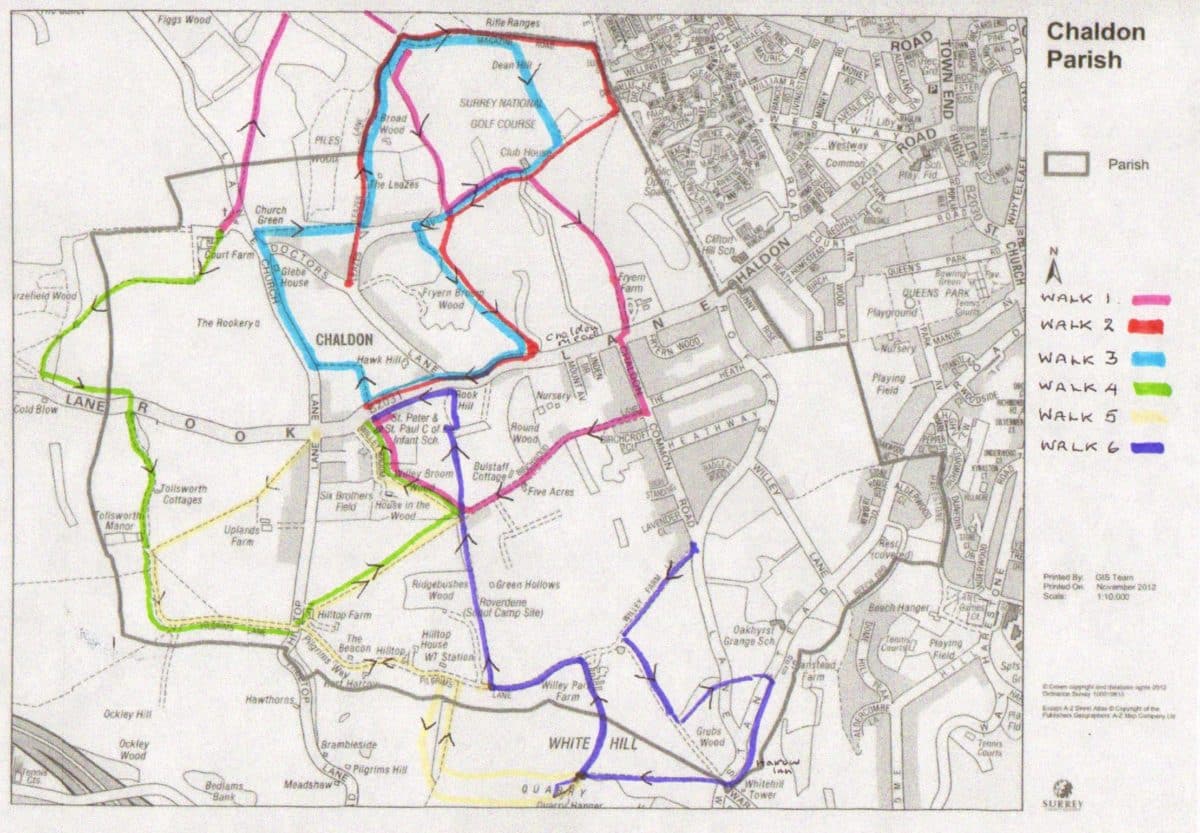
Chaldon has a notable history of looking after its public paths and rights of way. Chaldon residents walked each of its footpaths regularly twice a year from the 1920s until a few years ago. Six walks covered the network of official paths and bridleways within the parish. Guides for four of the Chaldon Walks have been developed with two more due to be completed shortly. These Guides are an attempt to preserve the tradition of walking the paths and provide interesting historical detail, as well as some nature notes. Download and print them off to take with you (or read them on the sofa if you are shielding). If you don’t have a printer at home, then download the PDF onto your phone as there is limited signal on the routes. The Guides have been put together by Liz Bonsall with contributions from Adele Brand, Madeline Hutchins and Lizzy Maskey. Find them here https://chaldonhistory.org.uk/chaldon-walks/
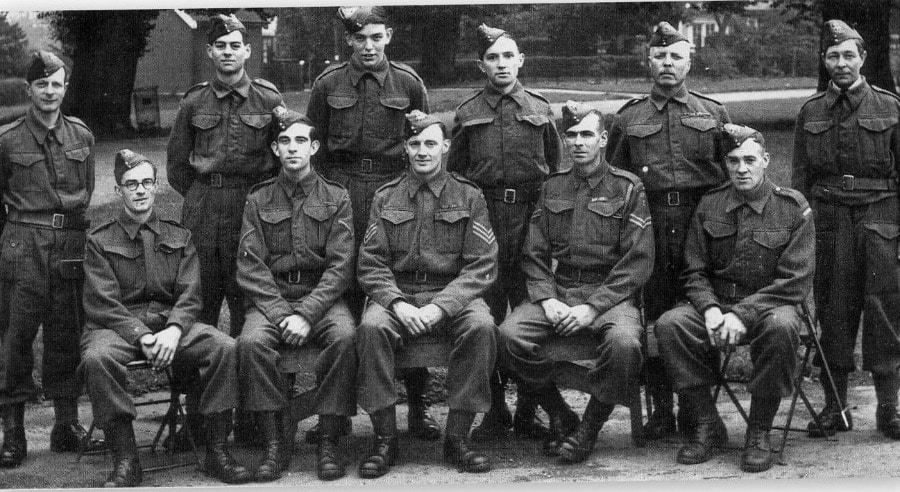
8th May 2020 is the 75th anniversary of VE Day, the end of the Second World War in Europe and to mark this occasion the Chaldon Village Council asked Liz Bonsall to write a piece about Chaldon in 1945, with its celebrations and the decisions on war memorials, for the newsletter, Chaldon Matters. The piece is reproduced here. Further information compiled by Liz Bonsall is on the page Chaldon in World War 2; where you will find the Chaldon Village Roll of Honour and extracts from Chaldon Association minutes of meetings 1938-1953 referring to wartime and memorial plans.
Chaldon in 1945
VE (Victory in Europe) Day was the name given to 8th May 1945 when the Allies celebrated the defeat of Nazi Germany formally recognising the end of the Second World War in Europe. It meant an end to nearly six years of a war that had lost the lives of millions. The war against Japan did not end until August 1945.
The news of Germany’s surrender was not surprising. It had been anticipated for some time and people were on standby to start celebrating. The news came on the evening of 7th May and a national holiday was immediately declared for the following day.
In Chaldon local celebrations were fairly low key. Canon Crawford had written a Victory note in the Church News to tell parishioners how Thanksgiving would be offered. He said “On the day itself the Children will have a Service when the School is dismissed: and for the older folk there will be special Services at 11am and 8pm when all will, we hope, want to come and our Church should be full.”
On 19th April 1945 the Chaldon Association had called a Public Meeting which was ‘crowded to capacity’ and gave evidence of “an earnest desire for a local memorial to mark our grateful appreciation of those who have risked and accomplished so much for us, and whom we look forward to welcome home.”
On the 6th June 1945 a Victory party was held for the children of Chaldon. It was held in a field in Chaldon Common Road and the children were entertained to tea of fancy cakes, jellies, blancmanges and ice-cream. Over a hundred children attended and enjoyed a firework display in the evening.
Ideas for memorials were discussed and argued over by a War Memorial Committee and culminated in the stained glass window at the Church, dedicated 16th November 1947, a memorial clock on the north face of the Village Hall unveiled 29th January 1949, a Book of Remembrance dedicated at the Church later that year and two brass plaques commemorating the fallen fixed inside the Village Hall.
On 23rd January 1946 Chaldon WI attended a Victory Party in the Guards Depot Methodist Church Hall where games and competitions were interspersed with dancing and fancy dress.
In June 1946 Victory Celebrations in Chaldon were marked by a Fete on the field next to the Village Hall. The weather on the day was dreadful and “it rained all day”. However, the children continued with their races and the evening concerts were well attended. Chaldon Village Fete continues to this day.
If you would like to know more about Chaldon in WW2 see the page, Chaldon in World War 2 here.
If you have any stories or photographs to share please contact Liz at lizbonsall@aol.com.
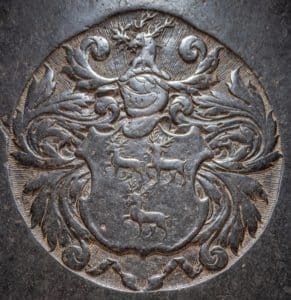
Coat of arms from Roane memorial stone in Chaldon Church
Saturday 14th March: 2pm to 4pm
in Chaldon Church, Church Lane, CR3 5AL
This talk was on the Roane family of Tollsworth (resident there in the 17th and 18th centuries) and their probable connection to the family of John Roan (d. 1644) of Greenwich who founded schools there which continue to this day.
This talk, given by Dr. Ian Brown, (resident of Chaldon and old boy of Roan Grammar School, Greenwich) was held in Chaldon Church which has two memorials / stones to Roane family members in the central aisle.
A joint event with the Friends of Chaldon Church, to whom the proceeds of £255 were given for the upkeep of the historic building.
Garden finds from Chaldon CourtSaturday 18th January 2pm to 4pm
Chaldon Village Hall, Rook Lane, Chaldon
LOOK WHAT I FOUND!
The Portable Antiquities Scheme and finds from Surrey: a talk by Simon Maslin, followed by identification of finds.
The Portable Antiquities Scheme is run by the British Museum and National Museum Wales to encourage the recording of archaeological objects found by members of the public. Every year many thousands of such finds are made, many by metal detector users, but also by people whilst out walking, gardening or going about their daily work. Dr Simon Maslin, County Finds Liaison Officer for Surrey, explained the work of the scheme and showed images and told the stories of some of the archaeological objects found locally.
After the talk, Simon Maslin looked at finds from Chaldon, brought by those attending the talk.
The Portable Antiquities Scheme generally only records objects which are more than 300 years old and of archaeological interest, so in terms of garden finds, anything 18th-20th century in date or of geological origin (i.e. fossils) do not need to be recorded but Simon Maslin was very happy to tell us what they were and talk to us about them.
A barbed-and-tanged arrowhead found in Chaldon Church graveyard in the 1990s. Illustration by Chris Taylor. The arrowhead is part of the Croydon Natural History & Scientific Society’s collection.
Peter Connelly of East Surrey Museum brought some of the famous finds from Chaldon in a display cabinet.
Wine bottle, probably late 17th century, found at Chaldon Court.
Flint hand-axe found in a garden in The Heath and reported to the Bourne Society in 1969. Illustration from the Bourne Society publication Guide to Local Antiquities by Michael Farley.
Two talks have been confirmed for January and March next year:
Saturday 18th January (2pm to 4pm) in Chaldon Village Hall
A talk by Simon Maslin, Portable Antiquities Officer, Surrey County Council, about his work and the Portable Antiquities Scheme, he will then help to identify any finds that you bring along.
Saturday 14th March (2pm to 4pm) in Chaldon Church
A talk by Ian Brown on the Roane family of Tollsworth and their (probable) connection to John Roan, founder of Roan Grammar School for Boys, Greenwich, and that branch of the family.
Henry Smoth’s tomb, All Saints church, Wandsworth, South London.
Saturday 9th November, 2pm – 4pm: Chaldon Church
The talk by Ted Howard covered details of the life of Henry Smith, a remarkable man, and of the many projects he supported before and after his death, including the modern role of the Charity in Chaldon.
Henry Smith was born to a poor family in Wandsworth in 1549 and died in 1628 at the age of 79 yrs. He was apprenticed to the Salter’s Company which produced and sold salt, rose to a senior position and became very wealthy. Henry bought many properties, including Knole House, Sevenoaks (leasing it back to the Sackville family), and he owned a very profitable iron business in the Weald. He was a great philanthropist and set up many charitable Trusts for the relief of poverty. These were particularly generous to the parishes in Surrey.
The original rules for the use of the money included:-
1. The provision of clothing and blankets for poor, elderly or infirm parishioners.
2. Financial help for the education of poor children or the support of apprentices over 15 years of age.
3. The provision of food for the poor on Sundays.
The rules have now been modernised and three Parish Trustees authorised by the Charity Commission are responsible for the distribution of the annual grants in Chaldon. The Henry Smith Charity is now one of the largest charitable funds in the UK and gives grants of approximately 27 million pounds per year. Henry would surely have been very gratified with the results of his philanthropy.
A joint event with the Friends of Chaldon Church, to whom the proceeds were given, to support the preservation of the ancient church building.
A walk round the boundaries of the Village/ Parish of Chaldon.
Beating the Bounds – Chaldon History Group & Friends of Chaldon Church supported by Chaldon Village Council and Caterham Festival.
This took place on Saturday 25th May 2019. Once again we had arranged to establish our territory with Caterham Hill Parishioners as we met with them on our boundary at Green Lane.
The walk started from Chaldon Church with a rest at the Harrow at around 1pm for lunch and finished at the church for tea.
See the Beating the Bounds page here for a brief history of the custom in Chaldon, and press cuttings from the past.
Over twenty of us had a wonderful walk, through fields and woods, on footpaths and quiet roads, round the village to find the sites of most of the 25 ponds that existed in Chaldon 150 years ago (on a map from 1868).
On the way there was a real sense of history and place, with fields and meadows, a wealth of wild flowers, butterflies, spectacular views, and evidence of life in the past.
Some sites had no signs at all that a pond had ever been there. Others were dry because it was summer and dry weather, but are known to have water in at other times of year. We saw farm ponds, the roadside pond in Rook Lane for those journeying through the village, the pond hidden in a deep quarried dip south of Tollsworth, and where a pond had been next to an isolated cottage or small house on the North Down’s Way (opposite the trig. point). The only signs of either cottage or pond now being pieces of pottery, china, glass and quarry tiles from a floor, found in the soil in the edge of the field. We peeped through bushes and peered down holes to see any sign The ‘real’ water filled ponds were found on Spring Bottom Lane, where the spring still provides a natural flow of clean water, once the water source for many in Chaldon. One member of the household had to walk down the hill, fill their buckets and carry them back up the hill on a yoke over their shoulders.
There was a lunch stop at the Harrow pub, and the walk ended with tea and cakes in the grass bowl at Chaldon Court that was once a pond.
£134 was given to the Friends of Chaldon Church from the £5 fees for the walk and the sale of teas and cakes.
The Well Tower and pond at Willey Farm, Chaldon, early 20th century.
Our visit this spring to the London Metropolitan Archives (LMA) was planned for Wednesday 10th April but has been postponed. We organised aa new date, 25th September but did not manage to fill enough places, so have had to cancel this visit.
The visit was planned as a group tour in the morning and to see selected maps and documents relating to Chaldon village and the church. There was the choice of staying on to undertake any personal research.
If any one is interested in making their own visit, the LMA is in Clerkenwell, half a mile from Farringdon Tube / British Rail. There are direct trains from Coulsdon South.
The archives holds original documents relating to Chaldon including a 1781 survey and map of the churchyard, some Church Faculty papers such as the levelling of the Tomlin family vault, the original Hassell painting of Chaldon Workhouse (Baker’s/Beggars’ Lodge) and the Burial Registers for the former Caterham Asylum.
The LMA has a vast library, original archive documents, computers to access digitised records including many wills of Chaldon people dating back to the 16th Century. Records include Chaldon Church records from the dioceses of Rochester, Winchester and Southwark and records from St Lawrence’s Hospital, whose lands and burial ground encroached on Chaldon.
The Archive is open until 7.30pm on a Wednesday so there is plenty of time to order documents of personal interest or explore the huge library. To explore what is available go to http://www.cityoflondon.gov.uk/lma
The website explains about registration for your History Card, lockers, lunch etc.